“The Favourite” Diary

We begin with Queen Anne, who is arguably the main protagonist of this story. She relaxes her neck, as the crown, which in real life is quite heavy, is removed from her head. In the final scene, she will bear down on Abigail’s head. When the two of them danced together, in happier times, Queen Anne repeated jokingly, “off with her head,” several times, as a part of a ritualized 1700s dance. This will not be the last of the film’s allusions to Alice in Wonderland.

Queen Anne gives Duchess Sarah a palace. Her glee at being able to surprise Sarah is infectious and is cute to see. Sadly, this is the healthiest we will see of Queen Anne in the entire film. It is difficult to imagine the character of Anne without her ailments, but I do wonder what the film would have been like, if most things had been the same, and Anne had been more physically strong.

The focus on health is further explored in the first real complex scene. It is a sequence that explores pain and agony. Abigail’s chemical burn, from being tricked into putting her whole hand into a bucket of lye, is overlaid onto a serious attack of the Queen’s gout. It is the first real time the two are going to be emotionally linked.

Here the audience first sees Abigail as a woman of action. As Queen Anne retells how she met Duchess Sarah, we see Abigail on a mission to get some herbs, first to soothe her hand and later to sooth the Queen.

As the Queen says Sarah’s pink shoes “disappeared,” Abigail rides off gallantly into the dark, of the early morning. As the Queen says the Cheever boy was removed, with a “crack,” Abigail looks up, startled, in the woods, since technically she should not be out here and has stolen a horse.

Abigail’s initiative earns her an initial reprieve, from her hitherto brutal existence. When the Queen passes by, in her wheelchair, Abigail’s cough seems legitimate, but in a world where her predicament is exceedingly precarious, Abigail is quick to claim credit for the herb, to which the Queen wonders, “That was you?”

Thus, Abigail begins to see into the world of Queen Anne. She becomes figuratively caught in a tug of war, between the Queen and Duchess Sarah, over a cup of hot chocolate, being forced, like a robot, to announce “I do not know what to do.” Little did they all know, this would not be the last of Queen Anne and Duchess Sarah’s tug-of-wars, over Abigail – only the least harmful.

Sarah finally relents and lets Queen Anne have her cup of hot chocolate, but doesn’t fail to embarrass Queen Anne, in the same sentence. Contrast this to a therapeutic mud bath Abigail takes Queen Anne to later, where Abigail comforts the Queen, telling her to imagine she is bathing in a tub of hot chocolate.

Irritated at been humiliated by Duchess Sarah, over breakfast – and in front of Abigail, no less – Queen Anne powerfully kicks out the chair holding up her hurt foot and demands to be taken back to her chambers. They begin the long, winding walk, down the dark hallway, to the Queen’s room, which will continue to symbolize Sarah and Anne’s relationship (Sarah will make this trip alone, shaken, twice). At the end of this specific journey, Anne, always looking regal, even in repose, is left alone in her stately quarters, still visibly upset, and hurt. It is truly lonely at the top.

The second major time, Queen Anne will be embarrassed and riled, by Duchess Sarah scolding her, in front of Abigail, will occur over a cup of tea, not hot chocolate. This cup of tea once again brings out Abigail’s knowledge of herbs, but this time for vastly different ends.

Duchess Sarah is sent off on a literal and psychosomatic trip, of Alice in Wonderland proportions, as “evil” music plays, and a naked man, who looks like the Devil, with a ‘horned’ wig, joyfully dodges a barrage of fruit, that leaves splatters that are meant to look like blood. It is the film’s best complex scene and does indeed deposit Sarah in the 1700s’ version of hell.

When Duchess Sarah returns, still looking dashing, in her now soiled, but once-white, spectacular riding and shooting coat, Queen Anne cannot bear to look at her, even going as far as to push Sarah out of bed. Obviously, Queen Anne has no knowledge of what Abigail did, but she feels guilt in benefiting and growing stronger, in Duchess Sarah’s absence.

Sarah demands that Queen Anne look at her, and her hideous scar, and Queen Anne cannot, an inversion of Queen Anne ordering the beleaguered servant boy to look at her, when she looked like a badger. The tables have turned; the one shouting to be seen is always the weaker person. From there Sarah’s falling out of favor, in the balance of power, only becomes more readily apparent.

Before, a clothed Sarah was able to mount a clothed Queen Anne, in bed, and was eagerly invited there. Post-scar, Sarah literally walks on to Queen Anne’s bed, in her riding boots no less, only to be bodily thrown overboard, in a bit of physical comedy, as Queen Anne hastily says goodnight. Indeed, it is Sarah who has now “fallen far.”

The climax of this maelstrom of events is the juxtaposition of the now insulted Duchess Sarah confronting Queen Anne, once again, in bed, now with a black sash around her face, but also a handful of blackmail letters – with Abigail handing Queen Anne, the box, with her ring, and both Queen Anne and Abigail catching each other’s glance and smiling, sharing a secret happiness between them. Sarah’s last desperate act had no chance of succeeding, and she is duly expelled.

However, Abigail isn’t going to escape unscathed. Abigail had a genuine care for the Queen, encouraging her to stop wallowing in self-pity, and take responsibility for the throne. Abigail and Queen Anne danced together. They trade off both saying the other is “not nothing” and calling the other beautiful. Queen Anne takes Abigail’s suggestion, involving a metaphor about a party, and becomes more competent, the face of her organization, not Duchess Sarah. Yet somehow Abigail still becomes complacent.

Abigail, now a Baroness, becomes the archetype of the decadent 1700s aristocrat. Her sham legal marriage is apparent, as she sits on some random guy’s lap, an echo, to when Duchess Sarah lovingly sat in the Queen’s lap, when they kissed, after a ball. When called to her actual “marriage,” with the Queen, she is rendered inadequate by alcohol.

Queen Anne is still understanding, even though now she can barely read, after being rendered even more ill, by a stroke. This was foreshadowed the last time the audience saw Queen Anne standing, when she initially has trouble making out, with her good eye, the bill to end the war. Abigail, who is almost always seen, in her free time, with a book, could have easily read to her “wife,” but instead throws up in a vase, ending the trinity of all three major characters throwing up, at least once, on screen.

Thus, the stage is set for the final scene. Everything, however vile, rude, or crass, has been played for laughs, until now, in which the true tragedy of the situation is painfully laid bare. When the curtain is drawn back, the audience sees Abigail, reading, as usual, like when she discovered Queen Anne and Duchess Sarah making love. She smirks as she steps on a rabbit’s spine, and Queen Anne understandably snaps.

Queen Anne who once, garbed in flowing royal winter robes, told Duchess Sarah powerfully, that she wasn’t making a point and kissed her, has been now rendered almost invalid, laid flat out by her ailments. Yet Abigail’s careless betrayal fills her with a kind of fury and energy we haven’t seen in Queen Anne before, for the entire film: a palpable spirit of malice. Even after Queen Anne crawls toward the door, once she stands up – blocking the door – it is clear that Abigail is going to be punished.

In the beginning, when they first met, Queen Anne is not interested in then-maid Abigail’s story and is about to dismiss her from the room – until Abigail notices the rabbits and genuinely calls them “gorgeous.” Their connection, over the animals, humanizes the both of them. By the end, the rabbits multiply over the screen nauseatingly and symbolize their mutual distress, as they are now locked in this loveless “marriage” forever, “til death do us part.”

Pocky Hero – The Importance of Citrus

Citrus tells a great love story; it is one of the best anime/mangas ever (it was on The New York Times’ bestseller manga list, for several weeks, in 2015). The plot is very deep and groundbreaking, as far as yuri stories are concerned. It is also an emotionally satisfying story, manga or otherwise. Conventions that are just taken for granted, in straight romances, dramas and sitcoms (many suitors, subverting stereotypes) are not yet as common in most yuri (and yaoi) stories.

Citrus is like Reply 1994, if the protagonists were in high school, instead of college. Yuzu is Najung. They are both the fiery, main protagonists. Mei is Trash. Mei is the quiet, studious one and Trash does eventually become a doctor. Both stories have a complicated family story, between the main couple, but it is OK for both pairings to be together. Mei is also like 은재 and Yuzu (유자) is like 예은, from Hello, My Twenties (Age of Youth). Mei and 은재’s backstories even both center around their fathers.

Ways that Citrus bucks the usual yuri and anime trends: 1) Mei and Yuzu are not childhood friends, nor does the story concoct a contorted, tortured backstory for them to have met in childhood. Both Yuzu and Mei have their own childhood friends, and the plot is about how those suitors are overcome, for Yuzu and Mei to fall in love with each other.

2) Even though Matsuri is pretty villainous and is a yandere foil, to Mei tsundere trope, the story is complex enough to not completely devalue her. Matsuri is redeemed after the conflict; she just wanted Yuzu very badly and was made cynical and desensitized by the Craigslist/Tinder world. That makes for better storytelling. Bonus: I like all the “action” scenes where Yuzu is running around trying to find or save Mei or when they ride Harumin’s bike to the train station, to see Mei’s dad off.

What I like about Citrus is that it helped people realize love between women can be rough too, even if it is consensual. Many viewers and readers appreciated the more realistic intensity. Women are just like men; we are just socialized not to fight each other physically – as much.

People misunderstand Mei or are intimidated by Mei, but I understand Mei, and like Sherlock, the tough or cool exterior, hides many emotional hurts underneath. Mei was raised by her dad and then he left Japan, to work and she was pretty much alone for five years, until the present, of Citrus, when she is 15. Emotionally, there are just a ton of things missing from Mei, that she will never be able to grow back, capabilities she will just have to go her whole life without.

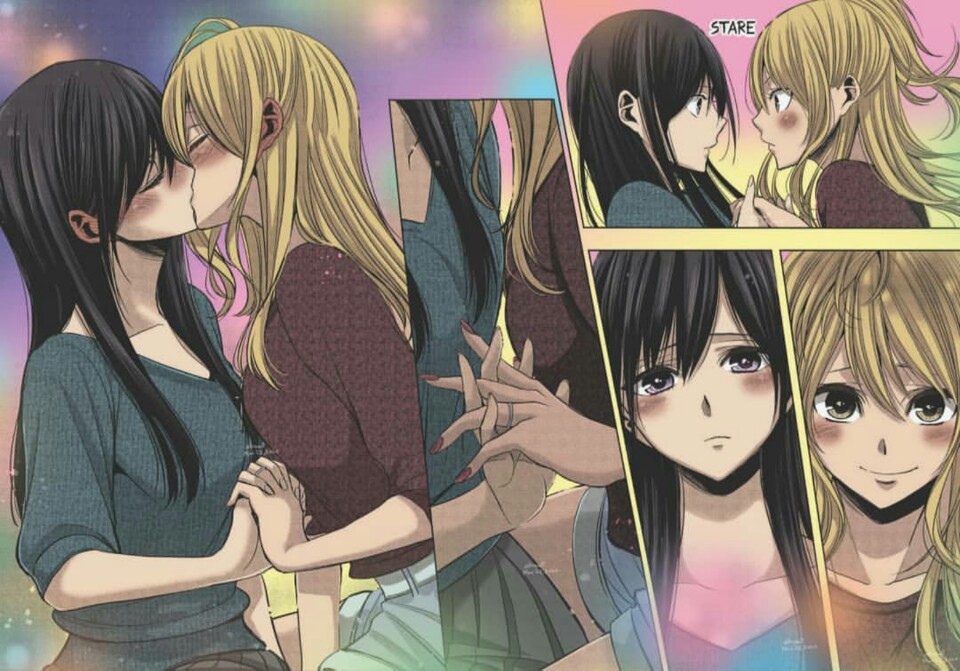
When you just look at Mei and Yuzu, Mei looks like the usual dominant one, even though she is the nerd and the 후배. The multi-faceted push-and-pull dynamic, between the two, is what makes Citrus great. Citrus, as I said, was and is so fascinating, because it subverts so many stereotypes and the usual tropes. For example, the nerd and the goody-two-shoes, Mei, is the more physically experienced one and the popular one, Yuzu, is actually the more romantic one, and her first kiss is with Mei. This is almost unheard of in mainstream yuri fiction.

Also, Yuzu, by a few months, is the 언니 here. That is why she vacillated so much on hooking up with Mei and whether Mei should be the dominant one. Mei being the dominant one sounds good too; I can just understand Yuzu’s feelings here, also. The idea that Yuzu hesitated so much on the physical aspect, of their relationship, because Yuzu wanted to be the dominant one, makes sense to me. The fact that Yuzu was the less experienced one, in these matters, and not Mei, did bother Yuzu, at one point.

Mei is like Rei, with a backbone and Yuzu is Asuka, but turned down a few notches. In a way, Rei and Asuka did finally end up together. Another parallel: Asuka grew up in Germany; Yuzu wears the gyaru style, a Japanese fashion trend influenced by the West and Baywatch. It was a look, in Japan, that was really popular in the 2000s, along with other ’80s-type things. An Asuka, in real life, might be too much, even if she means well. I like Yuzu, from Citrus, better. The author, Saburouta, toned the extroverted-ness down, to a level more geared toward playing the protagonist. Normally Mei would be the protagonist of a yuri story, like Citrus.
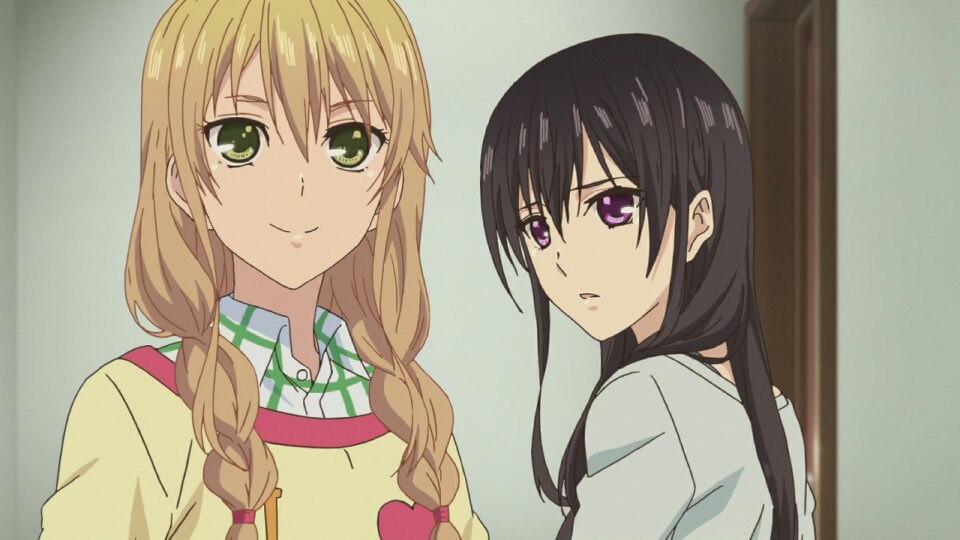
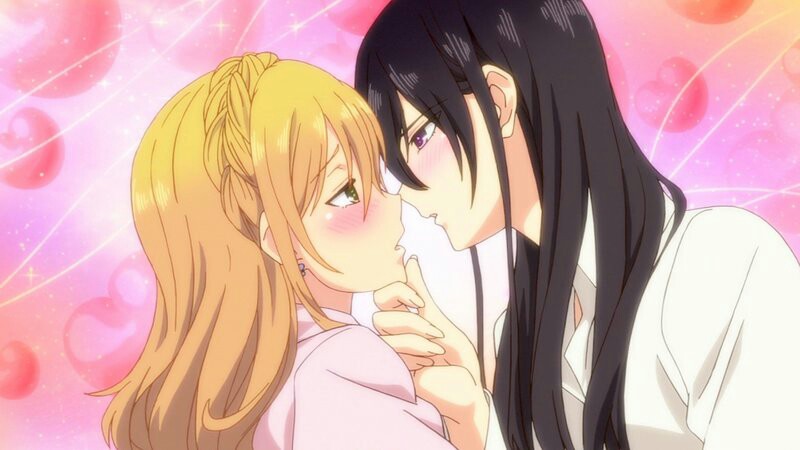
What is interesting too, is that regardless of kisses, hook-ups or other relationships, neither Yuzu, nor Mei were ever in love before – until they fell in love with each other. Finally, Citrus turns the stereotypes on its head, by making the nerdy one (Mei) be the one everyone wants to be with and making the popular one (Yuzu) fight for her love. It is usually the other way around.

The author does not make you wait, until the last episode, for a kiss, between the main couple. There is a kiss in almost every episode, usually between the main couple. The action is just so awesome that the author does not need to make the plot revolve around will they or won’t they kiss or hook up. There are enough gay or bi female characters for there to be many gay ships and many people vying for the protagonists’ attention.

Gay love is not singled out, in general, in Citrus. It is just love. Sara and Matsuri, despite being a villain, say several important things, throughout the story, about gay visibility, and sex positivity. Also, you get to see a wider variety of gay women, than just the protagonists. The main couple doesn’t feel alone. Other women, in the story, immediately understand they are in love – also, in-part, because they are also competing for Mei or Yuzu’s attention too. That is way more interesting and funnier, as a story or a romance. Citrus treats yuri romance like any other romance. Yuzu and Mei are not treated like gay women but just women – women who also happen to be gay.

One last thing, that’s unique about Citrus, is that the mother, Ume, is present and loving. Mei and Yuzu try to understand their fathers: one who passed away and one who is cool, but whose work takes him abroad. In addition, then the action of the story can focus on navigating childhood friends and other potential female suitors and girlfriends, before the goal of Yuzu and Mei ending up together. This makes for a more evolved yuri romance tale. I hope more yuri stories are like this in the future.