
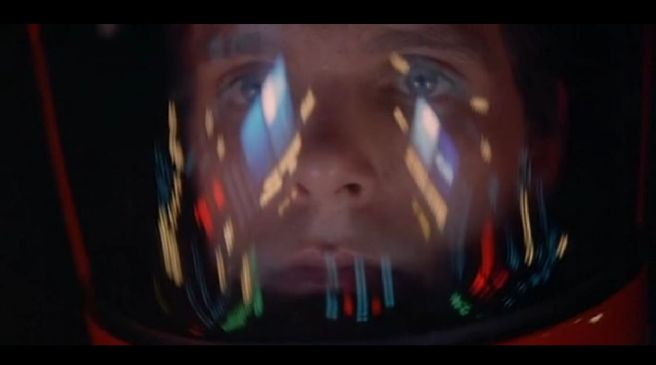
Of all the characters in “2001: A Space Odyssey,” the most memorable is the pensive, hyper-focused, if only a bit mournful, Bowman (given the music that plays when the crew is introduced, the Gayne Balley Suite, while he is running and drawing pictures of his comatose crew-mates in hibernation). He is like a cross between Faust and Beethoven, which is very Western, according to Oswald Spengler. Both Bowman and the Gayne Ballet Adagio capture the feeling of the Jupiter Mission: a kind of sorrow and ennui for what has gone before and a deep desire and a yearning for what comes next.
As in other Kubrick films, the music sets the tone – the sense of gravity. Equally important are the audible obscura, the periods where there is no music at all. As noted above, the Gayne Ballet Suite provides a sense of sadness and longing to Bowman and his crew.
- ‘The Blue Danube’ gives a sense of whimsy and airy lightness, a sense of a familiar commercial place, on the flight and on the space station
- ‘Also sprach Zarathustra’ gives a sense of victory, strength and power, as felt when the ape finally learns how to use the bone as a weapon
- ‘Requiem for a Soprano’ provides the sense of dread and visceral wonder when the monolith appears
- The silence in which only the hiss of oxygen and the rhythm of breathing can be heard when Bowman goes out in the pod gives a sense of sterility and underscores the indifference of the universe to the deaths of Poole and the other astronauts at the hands of HAL.
The silence also makes the sequence tense and gives it a subtle unspoken feeling of foreboding and a heightened sense of helplessness when HAL attacks. There’s nothing Bowman can do but watch as Poole futilely thrashes around in space, struggling to put his breathing tube back in his tank. Silence reigns as the hiss of life-giving oxygen is suddenly cut, in a combination of the two first major sins in the Bible: the sin of pride, and envy – in the Garden of Eden and Cain murdering Abel. Silence again, as Poole’s body, a tiny yellow-suited speck, floats away in space.
Later, we only hear the rush of air in the space ship and the life system monitors beeping plaintively as the three people in hibernation are silently murdered, and then simply the rush of air, as life functions cease, and finally, only the hiss of oxygen and Bowman’s breathing is heard again, as HAL is shut down. One truly gets the sense of being totally alone in space: the first human voice, other than Bowman’s, heard after Bowman’s ordeal, is a recording. Ground control was so dependent on HAL that there was no counter-contingency for communications being shut down.
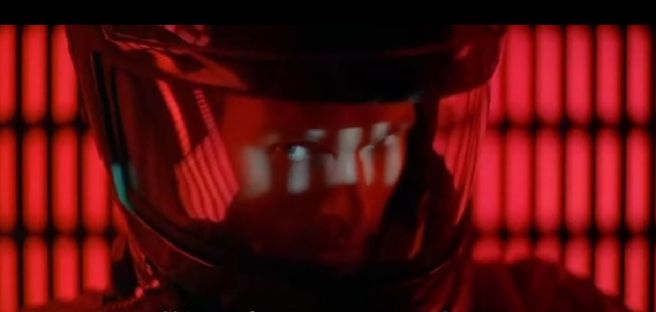
A nice visual element, that will become more important when Bowman enters the Star Gate, is the glare: how light reflects off faces (especially when a Bowman, deep in concentration, is going to collect Poole’s body) and off the outside of helmets. Most space films (like ‘Gravity,’ ‘Prometheus,’ etc.) edit out the glare or don’t use it in any capacity to convey information or any aesthetic qualities, in of themselves.
This visual detail is valuable and has an added effect: a light-show plays across Bowman’s unchanging face to reflect the graveness of the matter as he tries to retrieve Poole and faces down against HAL. Yet another totally different light-show plays across Bowman’s helmet and expressions of fear as he goes through the Star Gate. When Bowman is squaring off against HAL, the light on his face isn’t on accident, but serves to highlight the hardness of his features and give him a more threatening look, as tension mounts and he becomes angrier at the magnitude of what HAL has done.
So much acting is done with just the face, without saying a word. It is a film of subtleties – much better than the heavy-handed approach usually found in most sci-fi films. This is important, since the viewer spends most of the main part of the film staring back into Bowman’s eyes. The play of light is needed to make sure there is variation in the shot and to highlight Bowman’s face during scenes of heightened tension or to draw attention to changes in his expression and his emotion.
While letting go of Poole and confronting HAL he goes through a range of emotions: shock, determination, sadness, resignation, being at peace and so on. Kubrick pays attention to each detail of the light, how it’s angled and how it falls, to create strange new juxtapositions and images that are lasting and stay with the viewer, because they are unique and will never be seen anywhere else, despite said lighting coming from ordinary sources, like computer screens.
 A Piece, of the Sky
You must be logged in to post a comment.