Surface Effects

avatar 9

Of all the characters in “2001: A Space Odyssey,” the most memorable is the pensive, hyper-focused, if only a bit mournful, Bowman (given the music that plays when the crew is introduced, the Gayne Balley Suite, while he is running and drawing pictures of his comatose crew-mates in hibernation). He is like a cross between Faust and Beethoven, which is very Western, according to Oswald Spengler. Both Bowman and the Gayne Ballet Adagio capture the feeling of the Jupiter Mission: a kind of sorrow and ennui for what has gone before and a deep desire and a yearning for what comes next.

As in other Kubrick films, the music sets the tone – the sense of gravity. Equally important are the audible obscura, the periods where there is no music at all. As noted above, the Gayne Ballet Suite provides a sense of sadness and longing to Bowman and his crew.

  • ‘The Blue Danube’ gives a sense of whimsy and airy lightness, a sense of a familiar commercial place, on the flight and on the space station
  • ‘Also sprach Zarathustra’ gives a sense of victory, strength and power, as felt when the ape finally learns how to use the bone as a weapon
  • ‘Requiem for a Soprano’ provides the sense of dread and visceral wonder when the monolith appears
  • The silence in which only the hiss of oxygen and the rhythm of breathing can be heard when Bowman goes out in the pod gives a sense of sterility and underscores the indifference of the universe to the deaths of Poole and the other astronauts at the hands of HAL.

The silence also makes the sequence tense and gives it a subtle unspoken feeling of foreboding and a heightened sense of helplessness when HAL attacks. There’s nothing Bowman can do but watch as Poole futilely thrashes around in space, struggling to put his breathing tube back in his tank. Silence reigns as the hiss of life-giving oxygen is suddenly cut, in a combination of the two first major sins in the Bible: the sin of pride, and envy – in the Garden of Eden and Cain murdering Abel. Silence again, as Poole’s body, a tiny yellow-suited speck, floats away in space.

Later, we only hear the rush of air in the space ship and the life system monitors beeping plaintively as the three people in hibernation are silently murdered, and then simply the rush of air, as life functions cease, and finally, only the hiss of oxygen and Bowman’s breathing is heard again, as HAL is shut down. One truly gets the sense of being totally alone in space: the first human voice, other than Bowman’s, heard after Bowman’s ordeal, is a recording. Ground control was so dependent on HAL that there was no counter-contingency for communications being shut down.

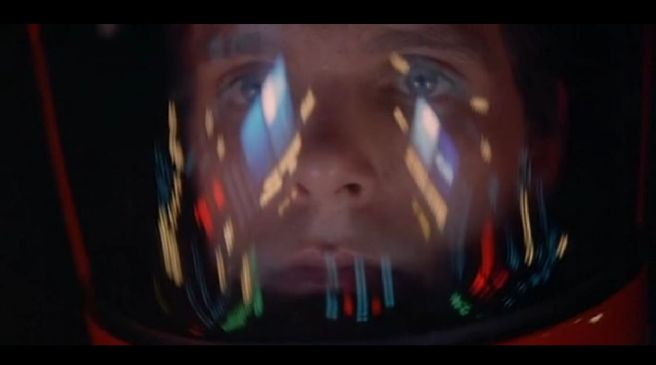
A nice visual element, that will become more important when Bowman enters the Star Gate, is the glare: how light reflects off faces (especially when a Bowman, deep in concentration, is going to collect Poole’s body) and off the outside of helmets. Most space films (like ‘Gravity,’ ‘Prometheus,’ etc.) edit out the glare or don’t use it in any capacity to convey information or any aesthetic qualities, in of themselves.

This visual detail is valuable and has an added effect: a light-show plays across Bowman’s unchanging face to reflect the graveness of the matter as he tries to retrieve Poole and faces down against HAL. Yet another totally different light-show plays across Bowman’s helmet and expressions of fear as he goes through the Star Gate. When Bowman is squaring off against HAL, the light on his face isn’t on accident, but serves to highlight the hardness of his features and give him a more threatening look, as tension mounts and he becomes angrier at the magnitude of what HAL has done.

So much acting is done with just the face, without saying a word. It is a film of subtleties – much better than the heavy-handed approach usually found in most sci-fi films. This is important, since the viewer spends most of the main part of the film staring back into Bowman’s eyes. The play of light is needed to make sure there is variation in the shot and to highlight Bowman’s face during scenes of heightened tension or to draw attention to changes in his expression and his emotion.

While letting go of Poole and confronting HAL he goes through a range of emotions: shock, determination, sadness, resignation, being at peace and so on. Kubrick pays attention to each detail of the light, how it’s angled and how it falls, to create strange new juxtapositions and images that are lasting and stay with the viewer, because they are unique and will never be seen anywhere else, despite said lighting coming from ordinary sources, like computer screens.
dsdff

A World Underground

discreet charm (2)

“Are you sure you want to do this?”

Alli nodded, one foot on the rope ladder, hands resting on the edge of the well.

Ran looked her in the eyes, and gave her a peck on the lips, “Alright, have fun on your adventure.”

“Well, Kaan did say this was the only dry well she’s ever found,” Alli remarked, “There’s no way I could come all the way back up here, and not check it out.”

“Be careful,” Ran said, switching on the flashlight mounted on Alli’s helmet.

“I will,” Alli smiled, “Stay on the walkie-talkie.”

She climbed down into the abyss. The pool of light above her head swam around the cold, stones, slick with the morning dew. The further down one went, the less likely that liquid was to evaporate.

As each rung sunk under the weight of her foot, she wondered what she was doing. Kaan had cited Aro’s advice to look for the blockage of the flow in a dry well. This was back when Kaan and Aspen had been still together. Then in Maine, Kaan had found the dry well in question. After exploring it, she offered it to Alli to use.

Ran’s head, swaddled in the red-orange corona of her hair, floated above Alli, on the surface. She was an auburn glow, looking down, crowned by the aura of the blue sky, sunlight filtering through the still empty branches.

It grew colder quickly, but Alli was in a puffy jacket. She seemed to descend forever. When her foot touched the wet dirt at the bottom, she looked up. Ran was still there and waved. Alli waved back. Like Kaan had explained, there was some sort of water main at the bottom of the well, a sewer leading farther into the bowels of the earth.

Alli waved to Ran once more, and disappeared into the ragged entrance, torn open by some water diversion crew years ago. The absence of natural light was felt immediately; the artificial light on her head bounced up and down with her movements, with each step into the gloom. She followed the slim stone catwalk, running along the channel of water, at the bottom of the well.

She tried to keep her heart’s rushing to a minimum. Other than the cloak-like darkness, the tunnel was peaceful. The underground brook gurgled. Tree roots hung from the ceiling. Occasionally, the muted rustling and shuffling of rodents, mice in the soil and crumbling or eroded parts of the walls, was heard, as they ran through their burrows.

Alli walked on in the darkness, for half an hour. The orb of light, a fluid conic section, danced along with her footfalls. The path sloped upward, and Alli struggled to keep her balance on the slippery rocks. As noted by Kaan, the passageway opened to another platform, the bottom of a second well, about two miles away.

The sky was the color of a robin’s eggshell. Cumulus clouds drifted over the opening, out to the distant sea. Alli sat down on the well bottom, looking up. Water glistened and rolled down the stones, past thin creeping vines, and fine, feathery plant growth, minute patches of lichen.

She held her knees and turned off the helmet flashlight. The morning cold gave way to the sunlight of early spring. She breathed in the musky smell of the damp undergrowth, tiny leaves, stunted in the half-light. She looked at the mute, unassuming stone wall in front of her, still covered in life, even several feet below the ground. Alli closed her eyes.

At this terminus, the path continued, but it was an immaterial path. In her mind’s eye, she was walking onward, stepping beyond the wall, seamlessly into the summer home of Nealy, located in the south of France.

The hallway was dark; only lit from the day, creating a chiaroscuro of white beams in a flurry of mites and dust. The red carpet was well-tread, but still soft, pliant. Alli crossed the hallway, dressed in a white jacket and pants, wearing a navy-blue pocket square.

Nealy was at her side, also in white, but sporting a red pocket square. They walked out to the main staircase and passed through the atrium, to the exterior of the house and the grounds.

Outside was a haze of orange light and strips of clouds hovered in the last minutes of twilight. They strolled the rolling promenade, not worried about getting grass on their white shoes. The evening was relaxing and cool after the heat of a summer day. The lawn was empty except for those two white-clad figures. It was just those two walking in the mists of time.

They reached a white swing hung from a stately oak. Alli sat down and Nealy stood up, holding the ropes of the swing. They looked on at the sinking sun, the pink sky, heard the chirping of the sparrows in the bush.

Will we never be this way again?

“The ghosts of time are always racing toward the sunset,” Nealy said, “There is an eye of the needle that they must squeeze through, to get back to their world, before night falls.”

The last embers of dying rays were being extinguished, consumed by the graying hills, the dark countryside.

Will I ever see you again?

Alli jolted awake, shivering in the night. Above her the circle of the sky was a midnight blue, dotted by stars. She shuddered and said into the walkie-talkie, “Ran, are you there?”

A pause, but then the connection crackled, “Yes, I am at Kaan’s cabin. I can see the other opening from the porch,” Ran said.

“I’m coming back,” Alli said.

She stood up, joints aching from being in one place, one position, for so long. She looked up at the post-twilight sky. The portal was closed. A memory was gone forever.

Criesandwhispers

Songs:

Dustin O’Halloran – “Opus 23”

Albinoni [attributed] – “Adagio in G Minor”

See Also: “The Wind-Up Bird Chronicle” and “Hard-Boiled Wonderland and the End of the World” by Haruki Murakami