Surface Effects

avatar 9

Of all the characters in “2001: A Space Odyssey,” the most memorable is the pensive, hyper-focused, if only a bit mournful, Bowman (given the music that plays when the crew is introduced, the Gayne Balley Suite, while he is running and drawing pictures of his comatose crew-mates in hibernation). He is like a cross between Faust and Beethoven, which is very Western, according to Oswald Spengler. Both Bowman and the Gayne Ballet Adagio capture the feeling of the Jupiter Mission: a kind of sorrow and ennui for what has gone before and a deep desire and a yearning for what comes next.

As in other Kubrick films, the music sets the tone – the sense of gravity. Equally important are the audible obscura, the periods where there is no music at all. As noted above, the Gayne Ballet Suite provides a sense of sadness and longing to Bowman and his crew.

  • ‘The Blue Danube’ gives a sense of whimsy and airy lightness, a sense of a familiar commercial place, on the flight and on the space station
  • ‘Also sprach Zarathustra’ gives a sense of victory, strength and power, as felt when the ape finally learns how to use the bone as a weapon
  • ‘Requiem for a Soprano’ provides the sense of dread and visceral wonder when the monolith appears
  • The silence in which only the hiss of oxygen and the rhythm of breathing can be heard when Bowman goes out in the pod gives a sense of sterility and underscores the indifference of the universe to the deaths of Poole and the other astronauts at the hands of HAL.

The silence also makes the sequence tense and gives it a subtle unspoken feeling of foreboding and a heightened sense of helplessness when HAL attacks. There’s nothing Bowman can do but watch as Poole futilely thrashes around in space, struggling to put his breathing tube back in his tank. Silence reigns as the hiss of life-giving oxygen is suddenly cut, in a combination of the two first major sins in the Bible: the sin of pride, and envy – in the Garden of Eden and Cain murdering Abel. Silence again, as Poole’s body, a tiny yellow-suited speck, floats away in space.

Later, we only hear the rush of air in the space ship and the life system monitors beeping plaintively as the three people in hibernation are silently murdered, and then simply the rush of air, as life functions cease, and finally, only the hiss of oxygen and Bowman’s breathing is heard again, as HAL is shut down. One truly gets the sense of being totally alone in space: the first human voice, other than Bowman’s, heard after Bowman’s ordeal, is a recording. Ground control was so dependent on HAL that there was no counter-contingency for communications being shut down.

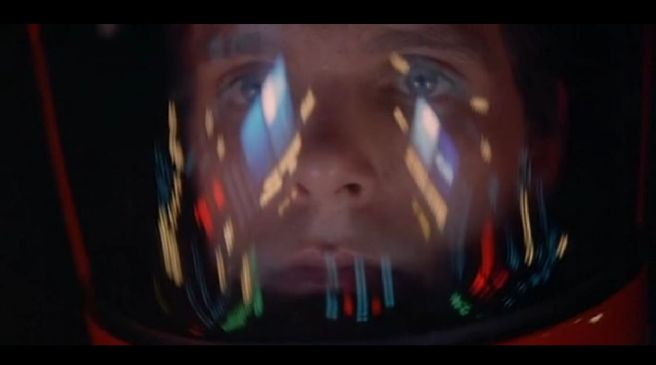
A nice visual element, that will become more important when Bowman enters the Star Gate, is the glare: how light reflects off faces (especially when a Bowman, deep in concentration, is going to collect Poole’s body) and off the outside of helmets. Most space films (like ‘Gravity,’ ‘Prometheus,’ etc.) edit out the glare or don’t use it in any capacity to convey information or any aesthetic qualities, in of themselves.

This visual detail is valuable and has an added effect: a light-show plays across Bowman’s unchanging face to reflect the graveness of the matter as he tries to retrieve Poole and faces down against HAL. Yet another totally different light-show plays across Bowman’s helmet and expressions of fear as he goes through the Star Gate. When Bowman is squaring off against HAL, the light on his face isn’t on accident, but serves to highlight the hardness of his features and give him a more threatening look, as tension mounts and he becomes angrier at the magnitude of what HAL has done.

So much acting is done with just the face, without saying a word. It is a film of subtleties – much better than the heavy-handed approach usually found in most sci-fi films. This is important, since the viewer spends most of the main part of the film staring back into Bowman’s eyes. The play of light is needed to make sure there is variation in the shot and to highlight Bowman’s face during scenes of heightened tension or to draw attention to changes in his expression and his emotion.

While letting go of Poole and confronting HAL he goes through a range of emotions: shock, determination, sadness, resignation, being at peace and so on. Kubrick pays attention to each detail of the light, how it’s angled and how it falls, to create strange new juxtapositions and images that are lasting and stay with the viewer, because they are unique and will never be seen anywhere else, despite said lighting coming from ordinary sources, like computer screens.
dsdff

A Donation of Sense

hibiki_saka_gunbu2

An instance of denotation, manifestation and signification failing to support sense, is Alice losing her name.[1a] Alice loses the name that denotes and signifies her. Hence, sense is separated from the three dimensions of proposition. There is a regressive denoting of further senses.[2a]  From Latin, and later, French – doner, donnes – comes the English word, “donate.” We are donated the “givens” in a problem. [3a] The problem preexists the answer. Alea, a game of chance,[4a] runs on lack and excess. There are no Ideal Forms, only forms, casts, events – points, sets, series, pips on a die. You have sets and series, with lack and excess moving between two sets.

In an identity, x = x. Sets hold various identities, including limits and singularities, placeholders, like zero. A singularity is a point or a non-point, like the eye of a storm or the center of a whorl of hair. In physics, black holes are singularities, rips in space-time. You could say singularities are points of pure becoming. A singularity is another point in a set; a point has zero dimensions.[1] Humpty Dumpty, an egg, has no organs; he is made of singularities instead. He lacks identity.

In losing her name, Alice gives off her incorporeal double. Doubles involve two entities going in two directions and good sense. There are the doubles, Tweedle-dee and Tweedledum, the Hare and the Hatter, but also the liminal in between. We have the Stoics’ Chrysippus effect and the law of the excluded middle, the infinite set, the limit and the convergence toward a limit. In the present, is the event, a point connecting to the infinite line of Aion, the ideal game, a line on a flat surface, the width, a frontier. The zero, the empty space, a floating signifier, is the ‘something,’ the aliquid, between the two sets. This given, in the problem preexisting answers, is the doner, the donation, between the two sets. Sense is that donation, the given – ‘that’s a given.’

Sense is the empty square between the two sets, the two series. Lack and excess define the two series, and the singularity is the event that provides coordination between the two sets. There are two sets, the signified and the signifying.

In the opposition between the surface and depths, the surface, the membrane between bodies and words, things and propositions, begins to break down and have holes. The body is a cavity with a broken surface; it is porous, with little holes. If there were no separation between propositions and things, words would enter bodies. Of course, this is not the case. In the world of depth, bodies are penetrated by other bodies, mixtures – this is a wound. On the other side, in a separate set, is sense, the event, an incorporeal effect, a surface effect. The surface effect, the pure ideal game is set apart; words are set aside from bodies.[2]

There is also the organism without organs, a body without organs, an egg, like Humpty Dumpty, or an embryo with undifferentiated organs, or a zygote with poles of cells, thresholds of potential. On the zygote are the animal and vegetative poles, active and passive poles of cells. The egg and Humpty Dumpty are points, singularities. They take in both sets of aspects – that of bodies but also skins, peelings, surface effects, events, sense – a body but a body without smaller, internal bodies, encased in membranes: a body without organs.

In the egg, this body without organs, there is no surface, no frontier, no difference or differentiation. The fish become a part of the sea, thus alluding to Humpty Dumpty’s poem including fish.[3] Are the fish apart of the sea or are they separate bodies? In this body without organs, between surface and depth, words enter bodies. Fire, water and air, classical elements, combine. Body and words become one – a strange amalgamation, like the portmanteau word.

Hecate is the goddess of the crossroads, the liminal and facing three ways. Circe, is an expression of Hecate, who is also the goddess of the moon. Circe turned the lotus eaters into pigs, a moment of pure becoming. There are lost pigs and other animals on Peter Pan’s island. Hecate and the nocturnal, connect to seemingly nonsense words: “lost pigs of the moon.”[4] Water and fire, classical elements, combine again. The combination of opposites points to the duality of the body: the fragmented body with separate organs and the body without organs. Peter Pan releases his shadow; both Peter Pan and Alice release their incorporeal doubles.

There is a difference between the nonsense of the surface and the two series, and the nonsense below sense and the surface, the nonsense of the depths, when the two series collapse into one. Sense slides along the surface width, between the two sets of signified and signifying. Meanwhile, there is no surface or difference between continuous bodies surrounded by their surface membranes, only depth. The lotus eaters are the nexus, the connection, between pigs and eating. Eating entails a digestive track from end to end, a tube, a hole, a tunnel, a surface of epithelium, running through the body, continuous with its surface; skin on the outside and the meeting of internal and external, inside and outside – one giant surface, running through a depth.[5]

Sense is the bi-directional line, like Aion, the divider between language and the body, protecting the body from language – when words pierce bodies, a wounding. Sense is the barrier, the mirror, keeping words, the incorporeal, proper names – and the body, bodies, the depths, separate. Sense is a singularity, an empty square, a supernumerary zero, moving between the two series of propositions and things, eating and speaking. There are two series, the body versus language and words.

Telescoping, Aion and Alice are unfolding, along an infinite line. Common sense, identity, is being eroded. The body goes back to being an egg, an undifferentiated body without organs. Doubles and doppelgangers appear in tandem – Hatter, Hare; Tweedle-dee, Tweedledum. The nonsense of depth is pitted against the nonsense of the surface.[6] The nonsense of depth, is corporeal; there is no surface or frontier – words pierce bodies and wound them. The surface collapses, pierced with many holes; it is porous.

The nonsense of the surface is the logic of sense, language, the incorporeal, the surface, the dividing line between the two series of language and bodies. The surface is like the surface of a body of water – it is easily pierced. Bodies pierce mixtures, producing surface effects, ripples. Sense is produced on the surface; when the surface collapses, sense collapses.

Sense is produced at the intersection of identity and direction. Sense doesn’t say its own sense – like nonsense – it further denotes in a serialization: n1, n2, n3; infinite regression, eternal return. Sense is the surface between words and bodies. A surface and the liminal space before it, are indivisible; they are two sides to one whole, like two-faced Janus: a double causality. There are two forms: the general and the individual, two perspectives,[7] surface versus depth. There are two series of singularities, with empty square and esoteric words, circulating between objects and words, bodies and language, signified and signifying.

Faro

[1a] The Logic of Sense, 18.

[2a] Ibid 31.

[3a] Ibid 55.

[4a] Ibid 58.

[1] Ibid. 80.

[2] Ibid 87.

[3] Ibid 89.

[4] Ibid 90.

[5] Ibid 91

[6] Ibid 92.

[7] Ibid 99.